
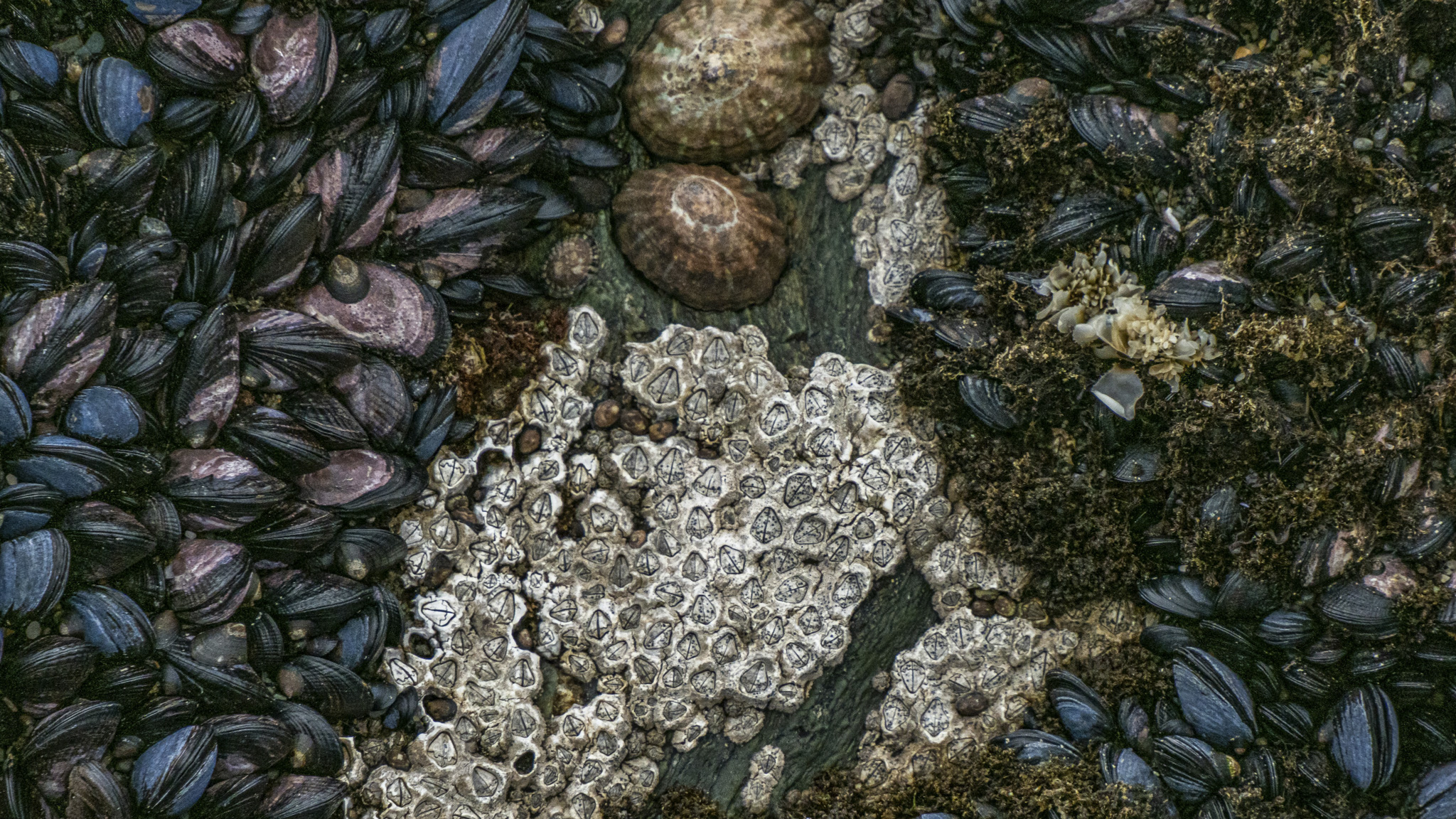
The rocks are wrong. That’s the first thing you notice before the smell reaches you, before you’ve picked your way down to the water line – something about the shore looks off. The mussel beds that should run in dark, continuous mats across the mid-zone are broken up, patched with bare stone. The shells are still there, but open. Bleached white inside. Whatever lived in them is gone. The rock itself is hot enough to make you pull your hand away. Not warm and inviting to sit on, the kind of heat that registers as a warning. Intertidal stone can hit 40°C during a heatwave, well above air temperature, and it holds that heat long after the sun has disappeared behind the horizon. You feel it through your shoes, a tingling sensation on the soles of your feet.
The smell arrives next. Not the clean salt-and-seaweed smell that belongs here. Something heavier. Sulphurous. Sweet in the wrong way. It’s the smell of organic matter cooking in the open air, of mussels that died in their shells and have been baking ever since. Beneath it, a sharper note: dying algae releasing dimethyl sulphide, the compound that normally gives the sea its character, here concentrated into something that reads as wrong before you can name it.
The anemones are still alive, technically. They’ve pulled into tight, deflated knots against the rock, barely recognisable, the colour gone out of them. No tentacle extended on the search for prey. Nothing is moving.
It’s quiet in a way that a shore at low tide shouldn’t be. No snapping shrimp, no gulls working the exposed rock. Just the occasional dry crack of a mussel shell expanding further in the heat. The air sits flat against the rock, faintly metallic at the back of your throat, tasting of something already lost.
To understand what’s changing, you have to look closely at the species that live between the tides.

Where the sea embraces the land
The intertidal zone is the strip of coastline that the ocean claims twice a day, everything sitting between the high and low tide marks. It can be a steep rocky ledge, a sloping sandy beach or a mudflat, each divided into distinct sub-zones and each with its own cast of species shaped by their ability to tolerate exposure to the elements. What can survive here already operates at the edge of what is physiologically possible, alternating between full submersion and open-air heat with every tidal cycle, 730 times a year. When the climate shifts, these species stand sentinel over a fragile ecosystem forever caught between land and sea. They are among the first to signal distress and each species can tell us a slightly different story of change.
Signals of ecological collapse
Mussels are not just simple inhabitants of the intertidal zone, to many others they are the habitat. Their dense, layered beds trap moisture, buffer temperatures, and create the microstructure that dozens of other species depend on as a refuge from environmental stress and predation. Lose them and you lose more than just the mussels. Mytilus edulis, the blue mussel we all know – and many like to eat – is a textbook ecosystem engineer. It is also acutely vulnerable. Biomimetic sensors placed inside mussel shells, so-called “robomussels”, have recorded body temperatures exceeding 30°C across consecutive days during heatwaves, with peaks above 40°C. Crucially, thermal tolerance drops with each successive heat exposure, meaning repeated heatwaves are more dangerous than isolated ones. The trajectory is already visible at a population level. Surveys across more than 400 km of the Gulf of Maine coastline show that mussel abundance has declined over the last 40 years and other sessile species track mussel cover closely, leading to fewer species sharing the rock with them.

The shrinking vertical world
At first glance, barnacles seem unremarkable – small, calcified cones glued to a rock. But look closer and you see that they live in distinct bands that you can read like contour lines on a map: Chthamalus highest, baking in the upper intertidal where it finds refuge from stronger competitors below; Semibalanus lower, where conditions are slightly less punishing. A shift of just a few centimeters can mean the difference between regular immersion and hours of desiccation. That precision is what makes barnacles sensitive climate indicators. Upper-shore barnacles already live close to their physiological limits, and during heatwaves, they are the first to die. Mortality increases sharply with aerial exposure and temperature, turning what looks like a stable band into a shifting threshold. As global warming intensifies, their habitable zone further compresses. Barnacles don’t move, but their boundaries do – redrawn with each extreme event.
Living thermometers
At high tide, sea anemones are all movement, tentacles extended, swaying in the water on the hunt for prey. But as the ocean recedes and temperatures rise, they contract into tight blobs, pulling in their tentacles and expelling water to reduce exposure. In extreme heat, some lose color altogether, turning into pale ghosts. They have no hard shell, no operculum to hide behind.
Despite this, intertidal anemones like Anthopleura elegantissima can survive temperature swings of up to 20°C across a single tidal cycle, a fluctuation that would be catastrophic for almost any other cnidarian. But tolerance has a ceiling. Seasonal monitoring of Actinia equina in the Mediterranean found that polyps shrank significantly during summer, with individuals consistently losing body mass at high temperatures. What was once a summer stress response has turned into a chronic condition. The anemone’s body can act as a real-time thermometer. And right now, it’s reading high.

Disappearing shade
Brown algae like Fucus and Ascophyllum drape across the mid-shore in dense canopies that, when the tide drops, act as insulation between the rock surface and the open air. During summer low tides, canopy cover can reduce peak surface temperatures by up to 5.5°C, creating refuges for small invertebrates and juvenile stages that would otherwise be exposed to lethal conditions.
It’s the difference between standing in direct sun on a hot day and stepping into shade of a large tree. The temperature feels different within seconds. The ground beneath the tree stays cooler, retains more moisture and shelters whatever lives in it. Remove the tree and the microclimate it created goes with it. The species that lived there weren’t adapted to the open sun, they were adapted to the shade.
These algae canopies are vulnerable to the same heat they buffer. Over the past 30 years, the southern range edge of Fucus vesiculosus has contracted northward by approximately 1,250 km along the Atlantic coast, tracking coastal sea surface temperatures that have warmed by an average of 0.2°C per decade. Where Fucus serratus has died back along the northern Spanish coast, at its warm distributional boundary, studies show rapid community shifts toward turf-forming species, with no functionally equivalent replacement for the canopy’s role in sustaining the food web. The loss of brown algae is not only a symptom of climate stress, it amplifies it and the species sheltering beneath it don’t adapt, they disappear.

Checks and balances
Grazers like sea urchins and limpets maintain the patchwork of bare rock and growth, preventing any single algae species from blanketing the shore. Limpets scrape microalgae from rock with a rasping tongue, while urchins crop back larger seaweeds. Climate change is putting that regulatory function under pressure.
The tiny limpets are often clamped to the same patch of rock for long times, actively defending their grazing territories that they rarely abandon. Under heat stress, they often reduce feeding as metabolism becomes constrained, slowing their grazing and allowing algal films to build up. Urchins respond differently. In the lower intertidal, where they remain submerged for longer, warming increases their metabolic rate and consumption. This strengthens the top-down pressure on algal communities at precisely the moment those communities are already stressed by heat. At the same time, warming disrupts the predators that keep urchin numbers in check.
What follows is a loss of control – one patch slips into overgrowth, another is stripped clean. The rock becomes a mosaic of competing outcomes, each shaped by how much heat its grazers can tolerate and how long they can keep feeding.
Come back to the shore. The mussel beds are still open, the insides still bleached, but they are no longer just a smelly nuisance, they mark a threshold crossed. The barnacle bands, once clean and continuous, begin to blur at the edges. The anemones, drawn tight against the rock, might not go back to their plump shade when the ocean embraces them once again. The patchwork of algae and bare stone reminds you of grazers that can no longer keep pace.
The rocks are still hot underfoot. The smell still hangs in the air. What you saw on the way down to the water line, that wrongness you felt before you could name it, was an accumulation of many small shifts, each species responding in its own way. The intertidal zone has always been a place of extremes. The tide still comes and goes twice a day. But between land and sea, the first signs of a changing ocean are already written in the lives of the species that cannot leave.
An Article by Kim-Isabelle Mayer
Photo credits (Unsplash): Trac Vu, EJ Strat, May Gauthier, Alek Newton, NOAA, Lesly Derksen