
He can already see the scorching heat shimmering above the asphalt that’s drawing closer with every step. A strip of glistening waves still lies between him and the feeling of having solid ground beneath his feet again. A drop makes its way down his temple, rolls along his cheek to his chin, and finally falls, as if wanting to join the sea before him, into the deep.
He doesn’t know whether it’s sweat or the last traces of his dive. The taste of salt still lingers on his lips as they curl into a broad smile. He thinks of his younger self, who, in this very moment, would be incredibly proud of the person he is now and how far he’s come.
Marco Casartelli considers himself lucky to pursue his passion at the King Abdullah University of Science and Technology in Saudi Arabia. With gratitude, he looks back on the collaboration with his colleagues, and especially with his advisor Raquel Peixoto, people who stand beside him day after day in the fight against climate change. Together, they have built a project that offers real hope.
The idea that bacteria might help protect corals fascinated him from the very beginning.
Just as the human body can benefit from probiotics, there is untapped potential in the microbial world of the ocean. Bacteria are isolated directly from healthy coral colonies. No genetic engineering, no artificial construction. They are screened for specific traits: Can they make iron bioavailable? Can they neutralize reactive oxygen species? Can they outcompete pathogens? Only those microbes that prove to be beneficial are used further.

What defines a “healthy” coral microbiome is a question science has wrestled with for years. There is no clear answer. Microbial composition shifts with species, environment, and stress. What matters most might not be which microbes are present, but what they do, whether they help during stress, defend against disease, or support the coral’s metabolism.
The risks of this work are minimal, precisely because only microorganisms that already exist in nature are used. No modification, no artificial production. Instead, it is a careful and respectful attempt to support the existing system and strengthen its natural abilities.
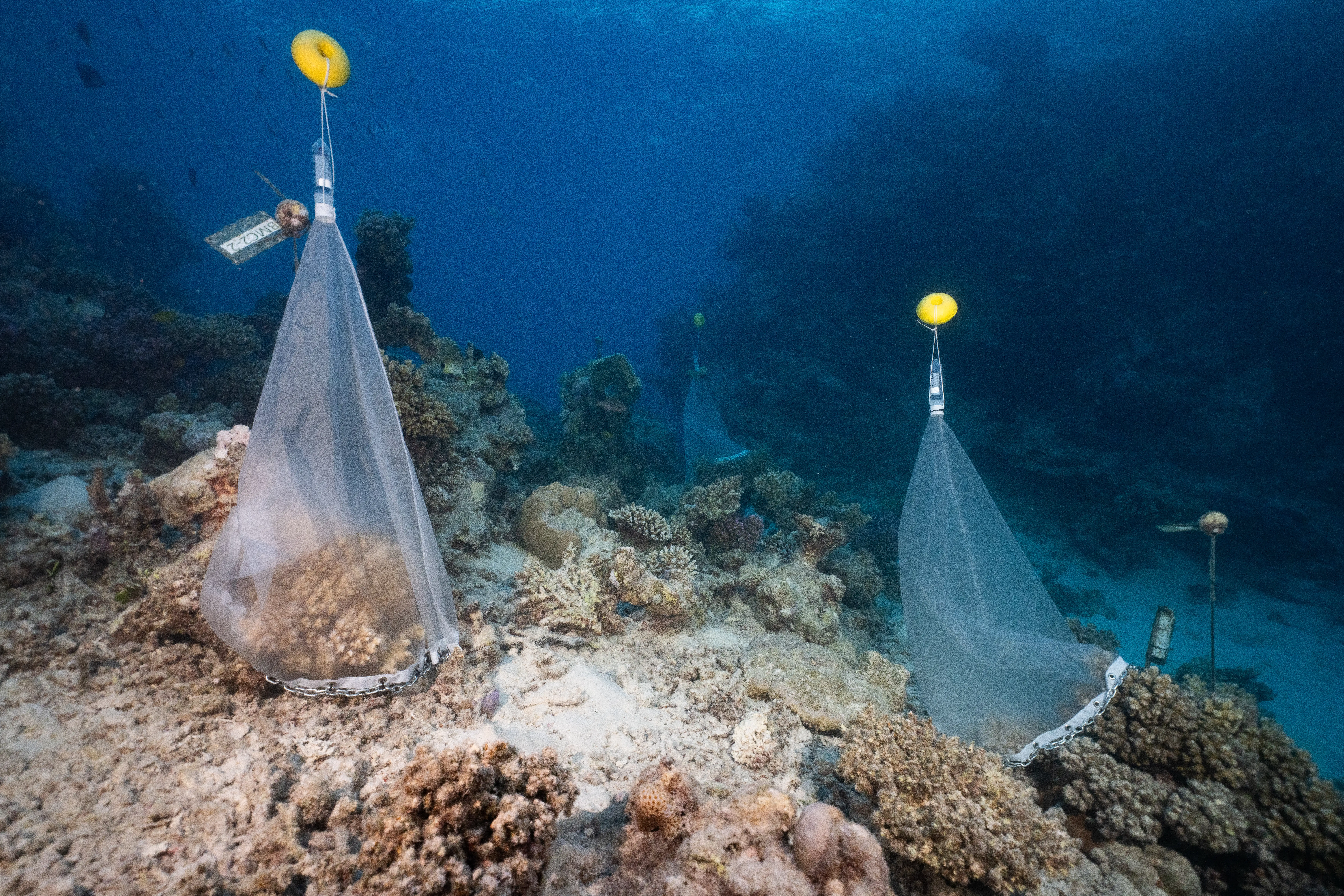
Although the idea of coral probiotics is still young and much of the research has taken place in the lab, early field experiments are promising.

They show that the coral microbiome can in fact be shifted through targeted intervention. Whether those changes result in lasting resilience is still being studied. But these microorganisms may well play a key role in helping corals cope with rising heat, nutrient limitations, or growing disease pressure.
Instead of using antibiotics, selected bacteria could offer precise, nature-based protection: a more sustainable and environmentally friendly solution. It is a quiet kind of work, microscopic in scale and yet of global importance.
Marco often finds himself reflecting on the emotional rollercoaster that comes with working in conservation. He has stood with a heavy heart, watching over vast stretches of dead reef, once full of life, now silent. Losses like these are hard to put into words.
And often, it is easy to get lost in the grief. There are countless studies that describe the situation as dramatic.
But Marco does not see it that way.
He holds onto hope. Because of people like Raquel Peixoto. Because of each and every one of his colleagues who have devoted their lives to coral conservation. Because of every single person who is slowly beginning to wake up.
Because of every coral spawn he gets to witness. Each one a tiny miracle of renewal that makes everything else fade for a moment.
People are beginning to care. And nature, he is convinced, still holds techniques and secrets we have yet to understand. Maybe, just maybe, some of them can be unlocked. Not to control nature. But to help her use her own weapons.
Biological Glossary
Bacteria – Microscopic single-celled organisms. Some are harmful, but many are beneficial and essential to life.
Bioavailable – A substance (like iron) is bioavailable if it can be easily absorbed and used by living organisms.
Coral microbiome – The community of microorganisms (mainly bacteria) that live on or inside coral and influence its health.
Genetic engineering – The direct modification of an organism’s DNA using biotechnology.
Microbe / Microorganism – A tiny organism, such as bacteria, that can be seen only under a microscope.
Microbial composition – The makeup or mix of different microbes in a certain environment or host (like coral).
Metabolism – The set of life-sustaining chemical reactions in organisms that convert food to energy and other necessary substances.
Pathogen – A microorganism (like certain bacteria or viruses) that causes disease.
Probiotic – Beneficial microbes that support the health of a host organism (used here in the context of corals, similar to their use in humans).
Reactive oxygen species (ROS) – Chemically reactive molecules containing oxygen. They can damage cells but are neutralized by antioxidants or certain microbes.
Resilience (biological) – The ability of an organism or ecosystem to recover from stress or disturbance.
Species – A group of similar organisms that can reproduce with each other and produce fertile offspring.
Trait – A specific characteristic or function of an organism, such as the ability to produce antioxidants or resist disease.
An Article by Carina Zettel, Interview with Marco Casartelli