
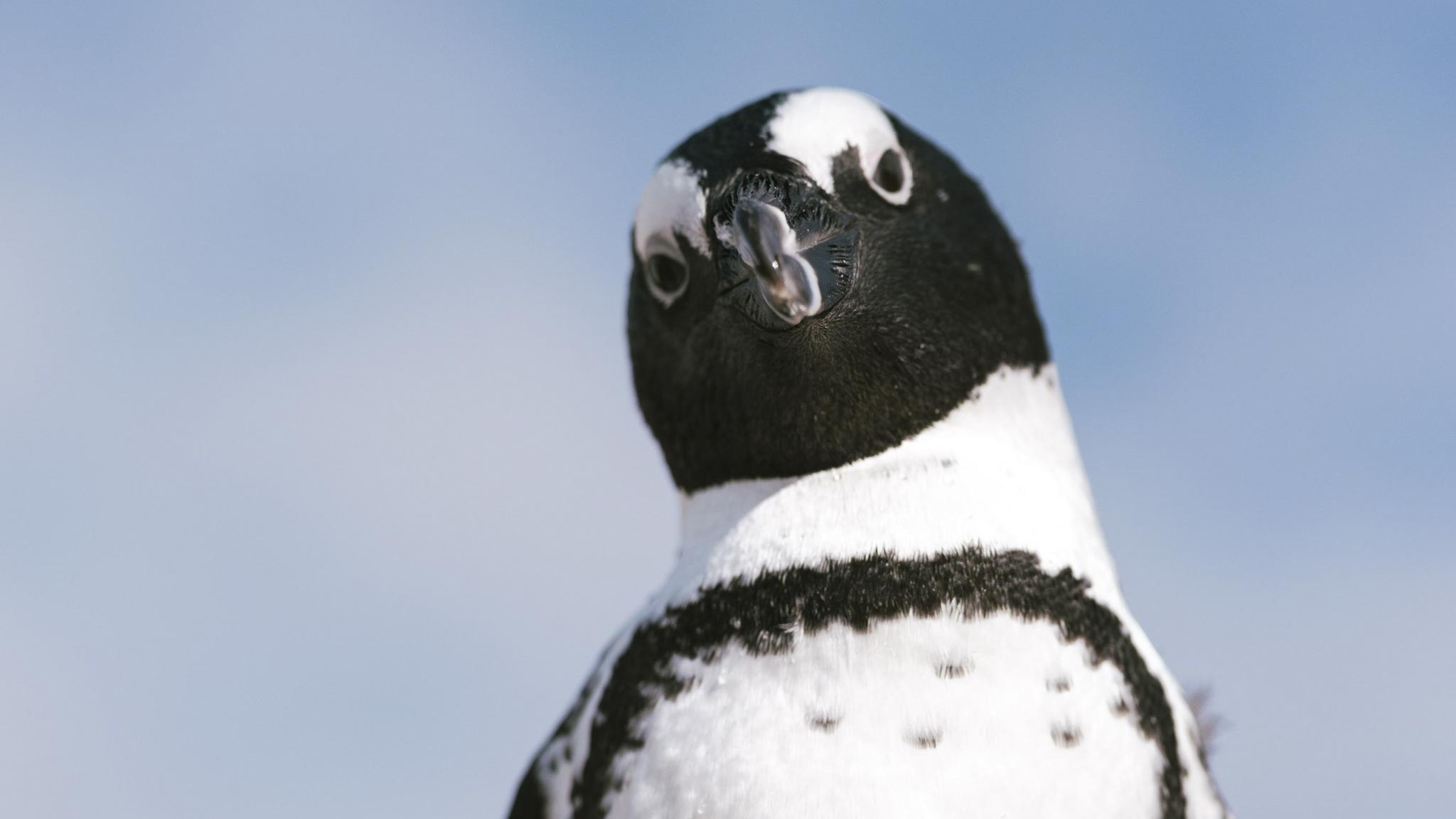
When most think of Africa, we often think lions, elephants, giraffes, or vast spaces filled with migrating wildebeest. Penguins are rarely the first animals that come to mind. Yet, along the western coast of South Africa and Namibia lives the remarkable African penguins (Spheniscus demersus).
These penguins – native to southern Africa – are found along rocky shores and islands, providing easy access to the sea and a safe, shaded place to rest during the hottest hours of the day. Adults are 55 – 70 cm in length, and have a life span of 10 to 15 years. Along their chests are black stripes that is unique to each penguin and assists scientists in identifying individuals.
African penguins feed mainly on horse mackerels, squids, southern African pilchards (sardines) and anchovies. They are equipped with webbed feet and flipper-like wings that allow them to swim with great speed and agility. Their foraging trips range from 30-70 km along the western coast and 110 km in Southern waters. They dive about 30 m on average, but can go up to 130 m when food is scarce while remaining underwater for approximately two and half minutes at a time.
Just like other penguin species African penguins form lifelong mating pairs and produce about one or two eggs per mating season. The mating season in Namibia peaks in November-December, while in South Africa it peaks in March-May. In contrast to their Antarctic siblings that nest on ice, they either nest in sand along the coast, or in burrows of accumulated guano (seabird excrement) built under rocks or trees to protect them from the African sun. After about 38-40 days the chicks hatch and are looked after by both parents for a period of 30 days. During this time parents alternate between caring for their chick(s), and hunting to provide food. After the 30 days, the chicks are left on their own, with the other chicks born in the season, while both parents hunt.

A popular place, and one of the best places, to observe the African penguin is at Boulders Beach near Simons Town, South Africa. Here, visitors can watch them up close, and even swim with the penguins. There is a thriving colony that has the distinctive smell of the African penguin, so be warned, but nevertheless it is an experience worth having.
Sadly, African penguins have had a shocking 97% decline since the early 1900s, which has placed them on the critically endangered list. With about 20 000 remaining in the wild, it is expected that they may be extinct by 2035 without intervention. The drastic decline is a result of a number of factors:
1. Food shortages – caused by commercial fishing, climate change that alter the water temperatures and shifts the ocean currents that move food sources further away from the colonies.
2. Increasing storms and coastal flooding – climate change not only changes food availability, but also increases flooding and storms along the coast.
3. Oil pollution – oil spills are one of the largest threats they face. A large number of ships along the coast spill oil as they refill the larger commercial ships. When these spills occur, weak regulations delay the time it takes for the spills to be cleared. Penguins swim into the spills, coating their feathers and affecting both their buoyance and insulation.
4. Loss of guano nesting habitats – guano is rich in nitrogen, potassium and phosphates – all essential in making fertilisers. For this reason, guano has been harvested at significantly high rates from the African penguin’s habitat. Guano deposits are essential in offering insulation, structure and support in nests. Its removal has decreased successful breeding, making chicks vulnerable to changing temperatures and nested on exposed surfaces.
African penguins are more than an iconic species — they are also important indicators of ocean health. Changes in their numbers often reflect changes in fish populations and marine ecosystem conditions, making their conservation valuable for understanding the broader state of southern Africa’s oceans.
Protecting African penguins means protecting the South African ecosystem and countless other species. Conservation organizations, researchers and volunteer groups are actively working towards preserving these very special African natives in the wild. Their survival will depend on sustained action, stronger environmental protection, and public support. I hope that with time the treats that they face will change allowing the populations to multiply. Without it the unique African penguin may disappear depriving the next generation with the opportunity to meet them.
An unforgettable final fact: African penguins are often called “jackass penguins” because of their loud, donkey-like braying call. It is a sound that has echoed along the southern African coast for centuries — and one that deserves to be heard by generations to come.
An Article by Hannah Frösler, photos by Louis White