
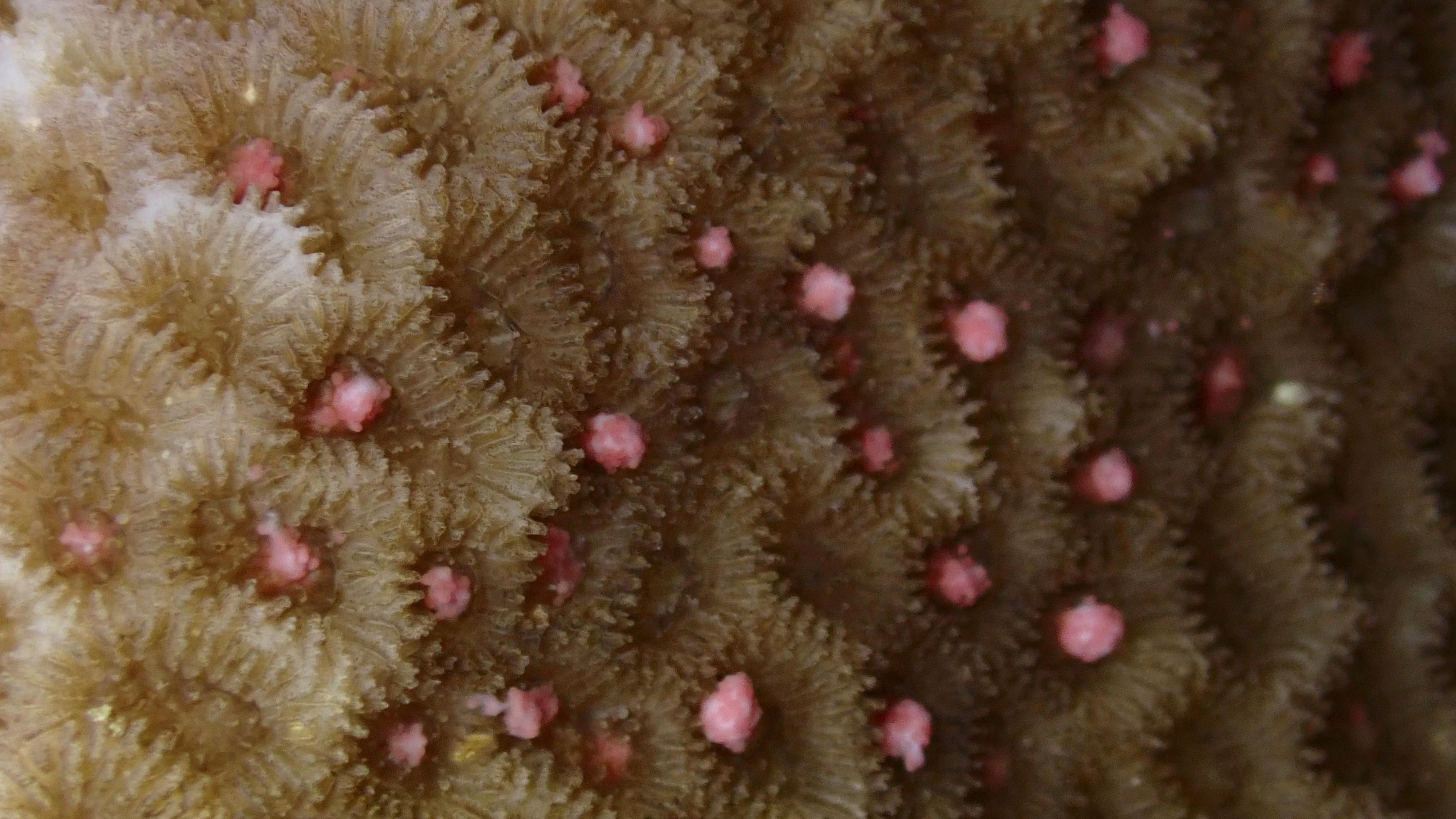
After several cooler months, the water begins to warm again. This gradual rise in temperature -so long as it remains within a normal range- doesn’t always lead to bleaching. Instead, combined with the lengthening days, it acts as a natural cue and triggering gametogenesis in coral. In response, coral colonies begin to prepare for reproduction together. As the temperature continues to rise, more and more colonies join in and produce gametes in remarkable synchrony. To align the exact day and hour of release, coral believed to respond to subtle environment signals such as lunar cycle and the timing of sunset.
Then, around two or three hours after sunset, something extraordinary happens. It looks as if snow is falling -but not from the sky. Instead, it drifts upward through the water column and rises toward the sea’s surface. This is mass coral spawning. In these moments, the ocean can turn shades of crimson, as billions of gametes ascend and blanket the water in a fleeting, breathtaking display of life.

Each coral genus has its own reproductive strategy. Most species produce both eggs and sperm and release them simultaneously while others specialize —producing only eggs or only sperm in each colony. Some skip releasing gametes altogether and instead release fully developed larvae. Brooding corals take a more protective approach. Rather than casting fragile gametes into the open sea, they nurture life within their tissues. When the time comes, they release fully formed larvae —quietly bypassing the most vulnerable stage and giving their offspring a stronger chance of survival.
Broadcast spawning corals, on the other hand, rely on scale and timing. They release either buoyant bundles containing both eggs and sperm or separate gametes into the water column. Even when packaged together, these bundles can’t self-fertilize so the successful reproduction depends on encountering gametes from other colonies of the same species. It is a delicate, synchronized, and extraordinary strategy —one that has allowed corals to persist for millions of years.

Why is coral spawning important?
Each gamete carries a genetic gift from its parent. Some may contain traits that enhance heat tolerance while others carry different advantages. Through cross-fertilization, these traits are reshuffled and allow the next generation to better adapt to changing environment conditions and increasing overall biodiversity. Producing eggs requires a significant amount of energy. As a result, only mature, healthy coral colonies with surplus energy reserves can successfully participate in spawning events. After the bleaching event, corals are often weakened and energy depleted so it makes reproduction difficult. When corals begin to spawn again after such stress, it is a powerful sign of recovery —a signal that these colonies are regaining their strength and resilience.

What can we do?
Four to six days after the full moon —just as the ocean begins to warm again after months of cooling —the stage is quietly set. Beneath the surface, coral colonies are preparing in synchrony, responding to cues written in the light, temperature, and time. For us, it is an invitation to slip into the water and become part of something rarely seen.
As night falls, the sea appears calm, almost ordinary. But patience is key. Around two hours after sunset, the transformation begins. This is not snow on the beach like in Taylor Swift’s song —it is “snow” beneath the waves. Tiny bundles rise from the reef, at first just a few then many more. It is worth staying up a little longer and postponing rest to witness this rare and extraordinary moment.
An Article and photos by Nabila Ayu Fitriani