
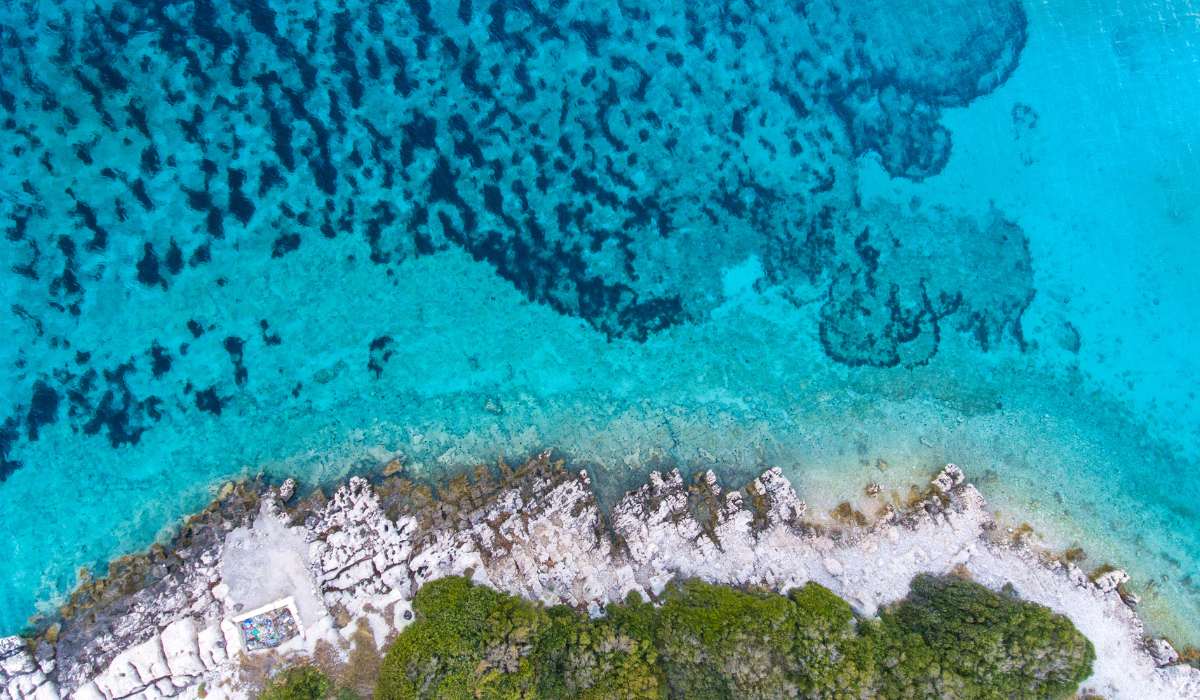
When we talk about the unexplored ocean, we often look far away. We imagine the deep sea, darkness, strange animals, and places almost impossible to reach. But for Anna-Lena Wallner, one of the most surprising discoveries of her first scientific project was that the unknown can begin much closer: right at the shore.
In the upper Adriatic Sea, between swimmers, rocks, sand, seaweed, and small coastal structures, there are still animals that can slip past our attention. Not because they are rare giants or spectacular deep-sea creatures, but because they are small, well hidden, and easy to overlook.
Anna-Lena’s bachelor thesis focused on cryptobenthic fishes: small, bottom-dwelling fish that live close to the seafloor and often hide in tiny spaces. They are part of coastal ecosystems, but they are not always easy to detect with common monitoring methods. For her, this was one of the first moments where the project suddenly felt real. While reading the literature, she noticed how little information there was on these fishes in the upper Adriatic. It was not just an exercise anymore. It was a real gap.
That moment, realizing that there was still so much to find out, even in a place as familiar as the Mediterranean coast, made her think: Oh wow, I am actually doing science now.


Learning to work with uncertainty
The project tested FARMS, short for fish-specific autonomous reef monitoring structures, for the first time in the Mediterranean Sea. These structures are built to mimic small hiding places: layers of PVC sheets and pipes of different sizes, creating shelters where cryptobenthic fishes might move in over time.
In theory, the idea sounds simple. Build small artificial habitats, place them in the water, wait, and see who arrives. In practice, it was much messier. The structures were deployed in Valsaline Bay near Pula, Croatia, at one, five, and fifteen meters depth.
The shallow structures could be reached while snorkeling, while the deeper ones needed free divers or scuba divers. For Anna-Lena, the fieldwork itself was one of the most exciting parts of the project. She loved being in the water, snorkeling around the sampling area, and seeing the work move from an idea on paper into something physical in the sea.
But fieldwork also meant learning that nature does not care about your plan. The one-meter site was hit hard by winter storms and waves. Several structures were damaged or destroyed, parts had to be collected again, and the setup had to be improved and redeployed. The shallow shore, which might seem like the easiest place to work, turned out to be one of the most difficult. It was accessible, but also exposed, changeable, and unpredictable.
For quite some time, Anna-Lena did not even know whether the structures would work. Maybe the fish would ignore them. Maybe the case study would produce too little data. Maybe all that effort would end in uncertainty. But that is also exactly what made it science. The turning point came when the FARMS were retrieved and opened.
After months of uncertainty, they were not empty. Fish had actually colonized them. For Anna-Lena, this was one of the happiest moments of the project: the method had worked, and the hidden fishes were finally visible. The structures cannot replace established sampling methods, but they added another way of seeing what usually stays hidden.
The shore as a place of discovery
Anna-Lena’s project shows that science does not always begin in remote places. Sometimes it begins in shallow water, with storms, repairs, coordination problems, and a lot of patience.
For a young scientist, it also means learning to stay with uncertainty. There are moments where the project feels exciting, and others where it is not clear whether anything will work at all. But that is also what makes the final result meaningful. Sampling the shore is therefore more than collecting fish. It is learning to notice what is easy to miss and realizing that discovery can happen very close to land.
An Article by Carina Zettel an interview with Anna-Lena Wallner