
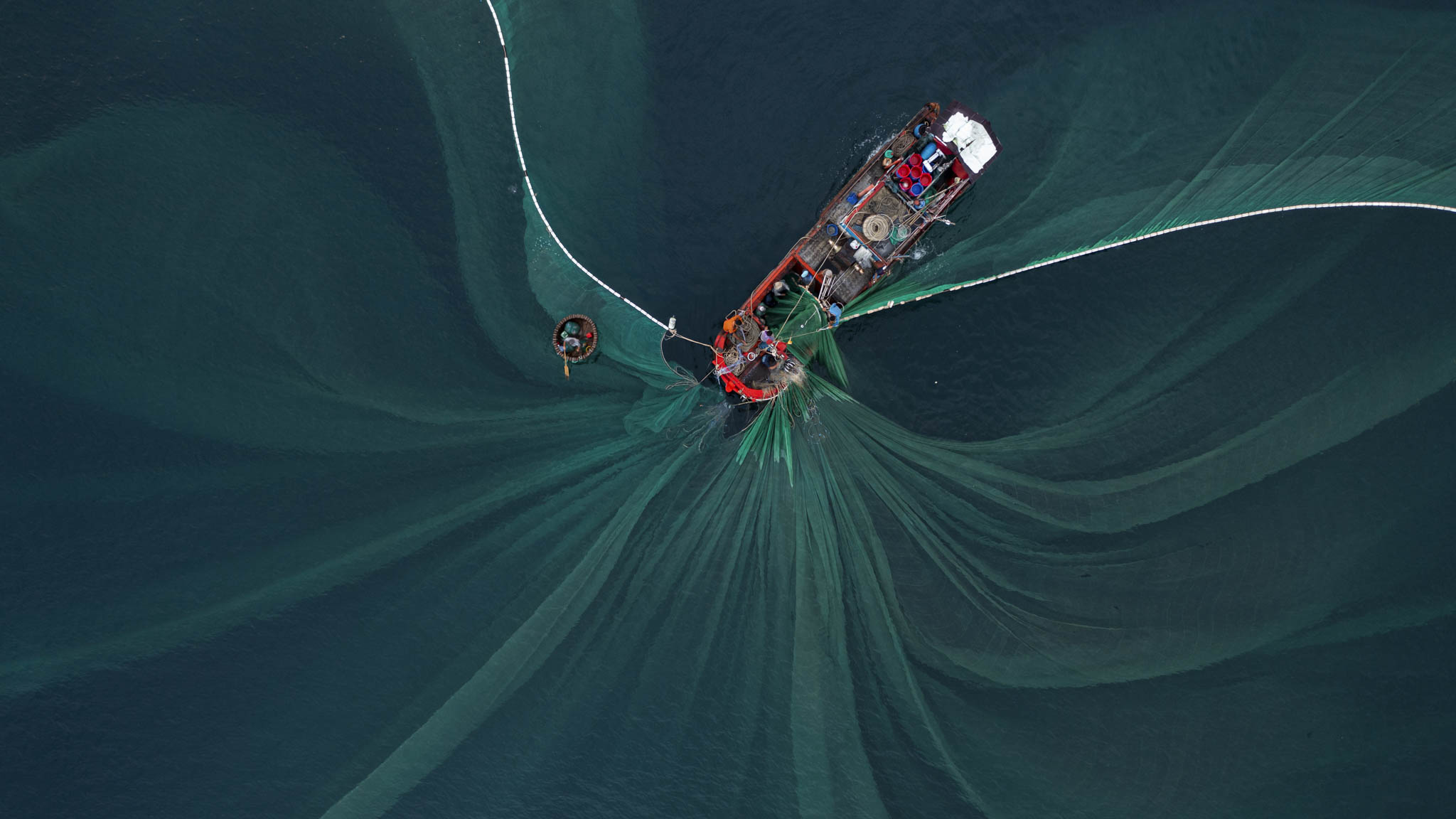
It’s 4am.
There are no lights.
No moon.
Just the stars out tonight.
The perfect conditions.
The fish know this, and they’ll be on their guard tonight.
As they were last night.
As they will be tomorrow night.
Illegal fishing has decimated fish populations globally. Experts estimate that illegal and unreported fishing costs the global economy up to $23 billion annually. But these are estimates since we know more about the moon than the ocean.
Illegal fishing statistics are also usually lumped together with unreported and unregulated fishing, under the acronym IUU. IUU fishing covers fishing in forbidden areas, accidental catches, and misreporting catches. This again makes finding accurate statistics on illegal fishing difficult. But in 2025, it was reported that illegal fishing is a bigger threat than piracyin some parts of the world.

These hidden numbers make illegal fishing a serious threat, because we do not know the full extent of the damage already done to the ocean or to ourselves. Millions of lives are connected to the fishing industry; when fish stocks collapse, communities around the world lose both their livelihoods and a vital source of food.
Illegal fishing directly undermines the viability of fish stocks through unchecked, unsustainable extraction. It also devastates marine ecosystems, in some cases wiping out entire species and weakening the ocean’s ability to remain resilient.
Thankfully, there are many working to combat the problem of illegal fishing.
Ships from Space
Satellite imagery is one method of surveillance. The Automatic Identification System (AIS) is a global system of monitoring ships. Each ship’s location can be seen on the AIS GPS systems along with their size, speed, registration number, and call sign. This system was initially designed to prevent vessel collisions and support safe navigation, but now has been used as a vital tool in preventing illegal fishing.
While effective when used properly, it does come with its limitations it can flag suspicious patterns, but it cannot quantify the true scale of illegal activity without being paired with other data sources and human investigation. For example, ship captains can turn of their AIS broadcasts. The information they send out can also be outdated, invalid, or manipulated. Smaller vessels are not mandated to carry a transponder.
Despite its flaws, AIS still has strong value for tackling illegal fishing because it is the least expensive system capable of monitoring both nearshore and high seas activity, with unencrypted signals that can be received widely, making it useful for spotting risk indicators of vessels conducting illegal fishing activity.

New peer-reviewed research also shows that when monitoring technology is combined with strong legal protection, illegal fishing can be effectively deterred. By fusing AIS data with satellite radar imagery and AI, researchers found that nearly 80% of fully and highly protected marine protected areas (MPAs) had no industrial fishing at all, and where violations did occur, they were typically brief and rare.
Strongly protected MPAs had nine times fewer fishing vessels than unprotected areas, demonstrating that strict rules meaningfully change behaviour. While AIS alone misses many vessels, its integration with satellites and AI closes critical blind spots, making illegal activity visible, enabling targeted enforcement, and proving that well-designed, well-monitored MPAs are effective tools for ocean recovery and long-term fisheries benefits.
The Work Continues
The next step to prevent illegal fishing is traceability – literally tracking seafood from the ocean to the plate. No single global system exists yet but there is a growing consensus among governments, industry, and consumers that transparency is essential. As global seafood trade expands and consumer demand for sustainable, legally sourced fish grows, traceability is becoming a market requirement to turn monitoring at sea into accountability across the entire supply chain.
An Article by Marla Lise