
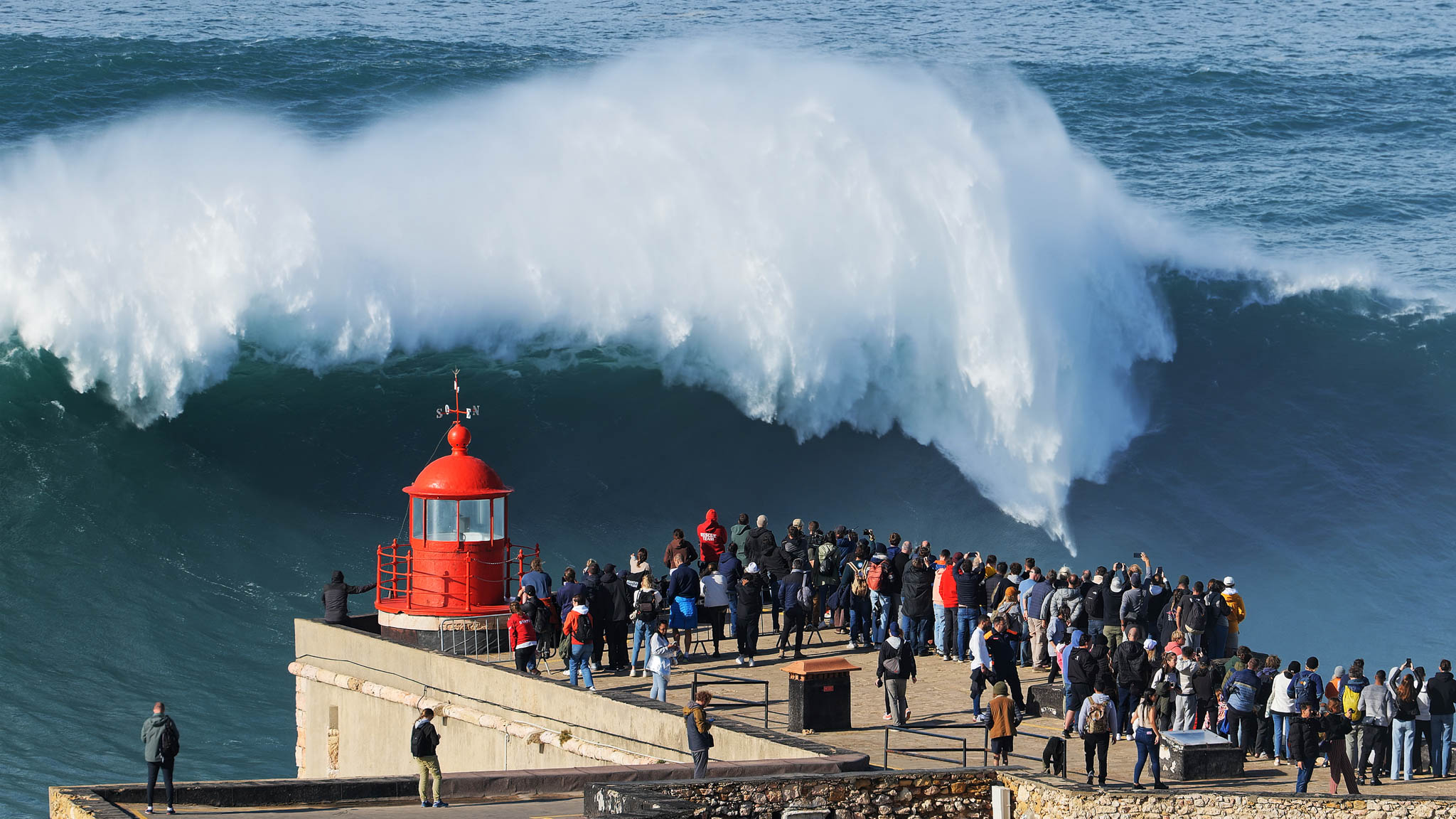
Imagine standing atop a rugged cliff at the edge of Portugal’s Atlantic coast, the old lighthouse and fortress at your back, the sun glinting on the red tile roofs of a sleepy seaside town below. On your left, gentle waves lap at the golden crescent of Praia da Nazaré. But turn your gaze to the right, to Praia do Norte and you’ll see the ocean conjure mountains of water that seem to rise from another world.
This is Nazare – as one of our biologist Malia Lukl experienced it this winter.
The Calm Before the Colossus
Nazare was once a quiet fishing village, its alleys lined with colourful traditional costumes and the scent of fresh fish. The town’s panorama village rooftops tumbling toward a serene bay belies the power just offshore. Today, as winter approaches each year, the Algarve sun gives way to roaring Atlantic storms that generate massive swells crossing thousands of kilometres of ocean.
The Secret Below: Nazaré Canyon
Beneath the surface lies the real architect of Nazare’s giants: the Nazaré Canyon, a submarine gorge plunging as deep as 5 km and stretching roughly 230 km seaward. Incoming ocean waves funnel into the canyon, compressing and amplifying themselves until as they approach the shallower continental shelf they explode upward with unimaginable force, producing waves 2–3× taller than normal Atlantic swells.
The Heartbeat of the Big Wave Season
Each year from October through March, Nazare’s giant wave season peaks and so does the town’s energy. From the clifftops around the Fort of São Miguel Arcanjo, thousands gather, pressing shoulder-to-shoulder, binoculars trained on the horizon, and cameras ready. Some visitors come for the thrill, others for the spectacle of nature but all quickly learn: you don’t truly feel the size of these waves until someone drops in.
From that vantage point, the waves seem like colossal walls of shimmering blue. But until a surfer rides them, they remain abstract motionless giants frozen in a photograph. When a surfer drops in crouching low as the wall rises behind them that’s when the scale becomes real. Onlookers erupt with cheers and gasps; this isn’t a contest here, it’s collective awe and support for anyone willing to challenge the sea’s fury.

Trust in the Team — Surfing With Jet Skis
At Nazare’s most potent peaks, paddling into a wave that moves faster than 60 km/h is nearly impossible. That’s why big wave surfers rely on tow-in surfing: jet skis driven by skilled partners sprint into the swell with a tow rope, accelerating the rider toward the wave’s crest so they can stand up in time.
This system creates an intense bond, the surfer must commit fully, one hesitation can mean disaster in the face of a 20–30 m wave. The Jet-ski driver must anticipate not only the wave’s motion but the surfer’s every move. And then there is the rescue team, alerted immediately if a wipeout occurs, often racing into a churning wall of foam and current.
It’s a ballet of precision, instinct, and trust and when it works, it’s poetry on water. When it doesn’t, the consequences can be life-threatening.
Records Written in Water
Nazare’s waves aren’t just tall, they rewrite history.
Sebastian Steudtner rode a wave measured ~28.57 m in February 2024, one of the tallest ever captured, awaiting official confirmation. Rodrigo Koxa surfed an ~24.4 m wave in 2017, holding a long-celebrated record. Maya Gabeira holds the women’s record with a 22.4 m ride in 2020. French big-wave star Justine Dupont holds the another female big wave record, recognized for riding a ~22.9 m face at Nazare.
Nazare’s big waves are not static, they’re living forces of nature, unpredictable and awe-inspiring. The town that sleeps in summer becomes a hive of adrenaline and anticipation in winter, as people from every walk of life gather to witness moments that might never be repeated. In every drop-in, in every cheer from the cliff-tops, there’s a shared recognition: here, we are reminded how vast the ocean and the human spirit can be.