
“I have yet to find any marine species that is completely immune to noise or vibration of any kind” – marine biologist Lindy Weilgart.
Imagine waking up in the morning to the gentle sound of birds chirping outside your window. While having your morning coffee, you exchange a few words with your family. On your way to work, you call a friend to discuss where you will meet for your next hangout, and at the bakery you order your breakfast by simply asking for your favorite bagel. For most of us, this kind of communication is completely normal and taken for granted.
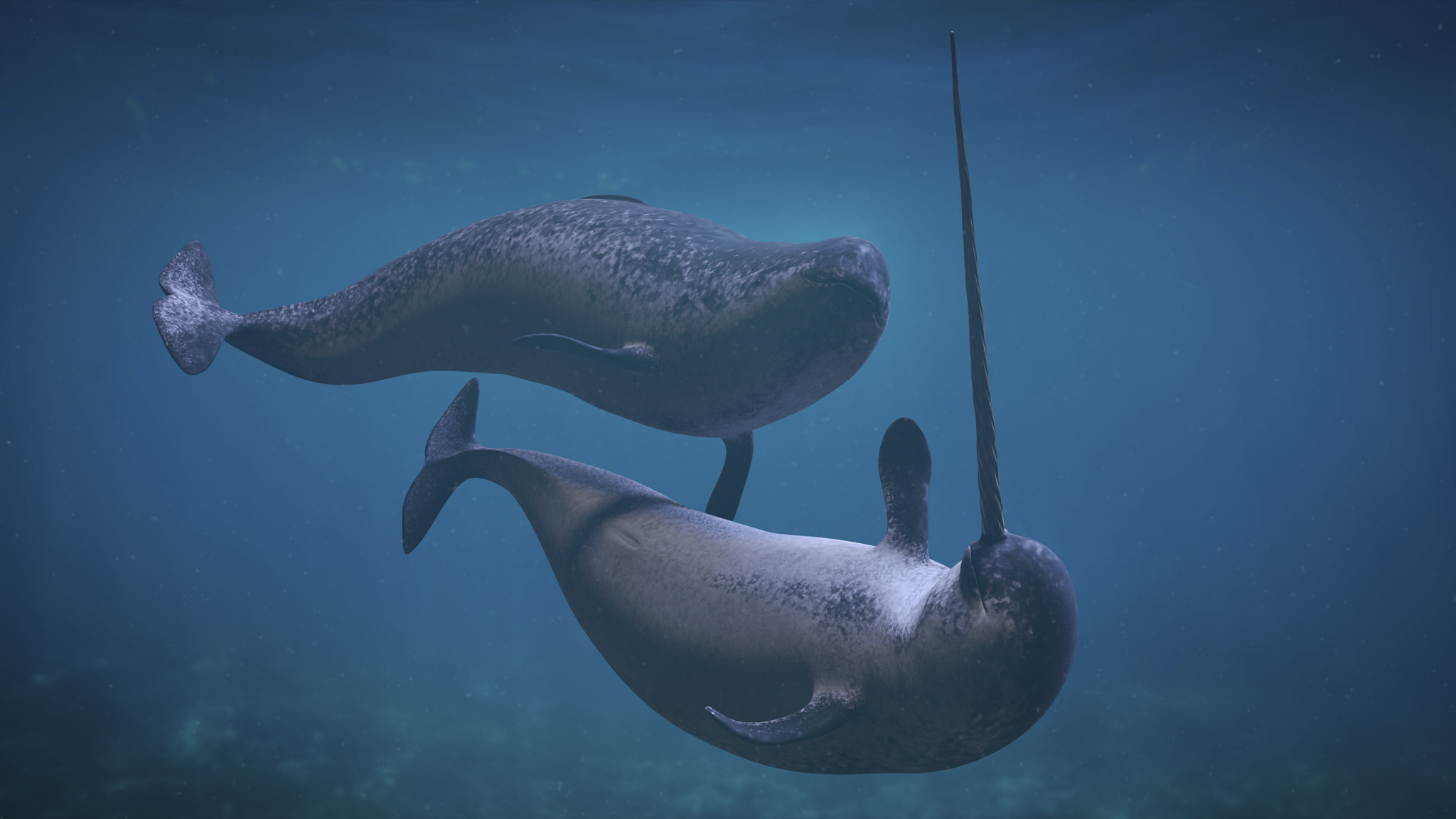
For narwhals and many other animals living in the Arctic, however, such simple communication has become almost impossible. Think about how irritated you feel when walking past a loud construction site: you struggle to hear your own voice and eventually tell your friend you will call back once the noise has passed. For narwhals, the noise rarely ever does pass.
Research conducted in the Arctic in 2023 on narwhals highlights the problem of underwater noise caused by large ships and their machinery, and the severe impact this noise has on marine life. Just as humans rely on sound to communicate, many marine species depend on sound underwater for social interaction. In addition, species such as whales use echolocation to hunt, find food, and survive, an absolutely essential function. The problem is that the frequencies used by many whales overlap with those produced by ships, causing constant interference. This effect is known as “masking”.

One might assume that affected animals could simply avoid ships, but underwater sound travels much faster and over far greater distances than sound in air. Ships can be heard from up to 40 kilometers away, and shipping routes have become so dense that avoiding them is nearly impossible. Humpback whales, narwhals, and many other species have already abandoned traditional feeding and mating grounds that had existed for generations, yet they struggle to find quieter alternatives. Some animals go silent altogether or become undetectable due to the overwhelming background noise.
Furthermore, since echolocation is also used for navigation, disruption caused by ship noise can at times lead to severe disorientation. In attempting to avoid noisy areas, animals often lose their sense of direction, resulting in fatal strandings along coastlines. In some cases, the intense noise can even cause physical harm.
What seems like background noise to human society has become a constant and life-threatening barrier for marine animals, fundamentally changing their ability to communicate, navigate, and survive in their natural environment.
Marine biologist Lindy Weilgart points out that this issue could, in theory, be solved. Ships do not benefit from being noisy; the sound is merely a byproduct of their operation and, in many cases, a waste of energy. However, the shipping industry is highly conservative, and meaningful change takes time and faces strong resistance.

an article by Carina Zettel