
Creatures, Extinctions, and Scientific Discoveries
Everybody has some idea of what our world looked like millions of years ago, mostly because of movies like Jurassic Park. Dinosaurs are popular, and almost every child knows what a T. rex or a Triceratops is. But what was happening in our oceans, where the origins of all life are thought to have begun about 3.5–4 billion years ago?
This article gives a short introduction to a few animals that lived in the oceans at different times and explains some common scientific methods used to study them.

Megalodon
Megalodon was the largest shark ever, living about 15.9 to 2.6 million years ago. Researchers analyzed fossil data using a statistical method called the Optimal Linear Estimation (OLE) model to estimate when it went extinct.
This method looks at the timing of the last fossil findings and the gaps between them. If fossils become rarer over time, it suggests the species was disappearing. Scientists ran 10,000 simulations, randomly selecting ages within fossil ranges. This produced a range of possible extinction dates. The most common result was about 2.6 million years ago.
This means it is very unlikely that Megalodon still exists today. Its extinction may have allowed large filter-feeding whales to evolve and dominate the oceans. It is also possible that Megalodon lost its main prey or could not adapt to changes in the ecosystem.
Ichthyosaurs
Ichthyosaurs lived during the Mesozoic Era, from about 250 to 90 million years ago, meaning they existed for around 160 million years.
They looked similar to dolphins, with streamlined bodies, a tail fin, and a dorsal fin, making them well adapted for fast swimming in the open ocean. Their skin was smooth, without scales, and they had a fat layer (blubber) like whales. Fossils also show pigment structures, suggesting they were dark on top and light underneath: A camouflage pattern still seen in modern marine animals.
Scientists studied many ichthyosaur fossils, especially rare ones with preserved soft tissues, not just bones. They used microscopy to examine structures like fibers and pigment cells, and chemical analysis to detect substances such as melanin or lipids. They also compared ichthyosaurs to modern animals like dolphins, whales, and sharks to better understand their swimming style, body shape, and fin function.
Horseshoe crabs

Horseshoe crabs live along coasts, especially in Atlantic North America. They are important for several reasons: their eggs are a food source for birds, their blood is used in medicine to detect bacteria, and they are used as bait in fishing.
They have a complex life cycle. They live in the ocean, come to beaches to lay eggs, and grow slowly, taking about 9–10 years to reach adulthood. However, increasing human use has put pressure on their populations, meaning better management is needed.
As fossils, horseshoe crabs are very ancient. They have existed for over 200 million years, and similar forms go back about 500 million years. This is why they are called “living fossils.” Their body structure has changed very little over time, and they are related to ancient animals like trilobites.
Ammonites and nautilids

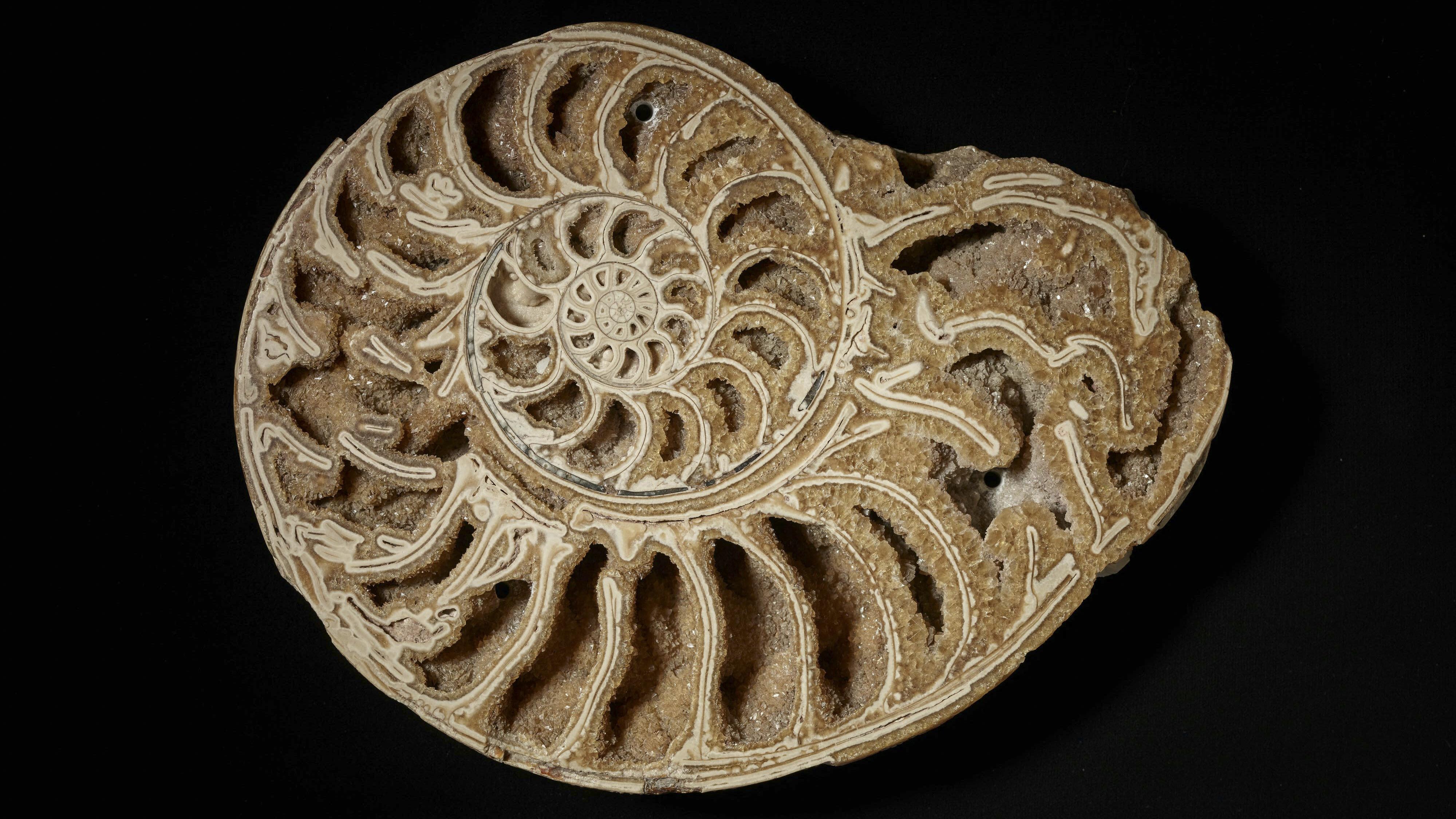
Ammonites were extinct marine animals related to squid. They had spiral shells and were very diverse and common in ancient oceans. Nautilids, such as Eutrephoceras, are close relatives of ammonites and still exist today. They also have chambered shells, but simpler ones.
The study examined 29 fossil sites worldwide and focused on the last 500,000 years before the mass extinction at the end of the Cretaceous. It used fossil data and stratigraphy to track where ammonites lived.
The results show that ammonites existed right up to the extinction boundary and then suddenly disappeared, suggesting a rapid extinction, likely linked to the asteroid impact. They were still widespread and successful before this event, so they were not already declining.
In contrast, some nautilids survived. Species with larger geographic ranges had better chances of survival. Nautilids may have lived in deeper water and had different lifestyles, which made them more resilient.
An Article by Carina Zettel