
For many people, Antarctica exists more as an idea than a real place. Endless white. Blinding snow. Howling wind. A land without cities, without trees, without people. Because almost no one will ever set foot there, Antarctica has become a perfect canvas for myths, misunderstandings, and half-truths.
Yet behind the curtain of ice lies a continent far more complex, alive, and surprising than popular imagination suggests.
A Land of Common Myths
Let’s start with the most famous confusion of all.
Penguins and polar bears together at last?
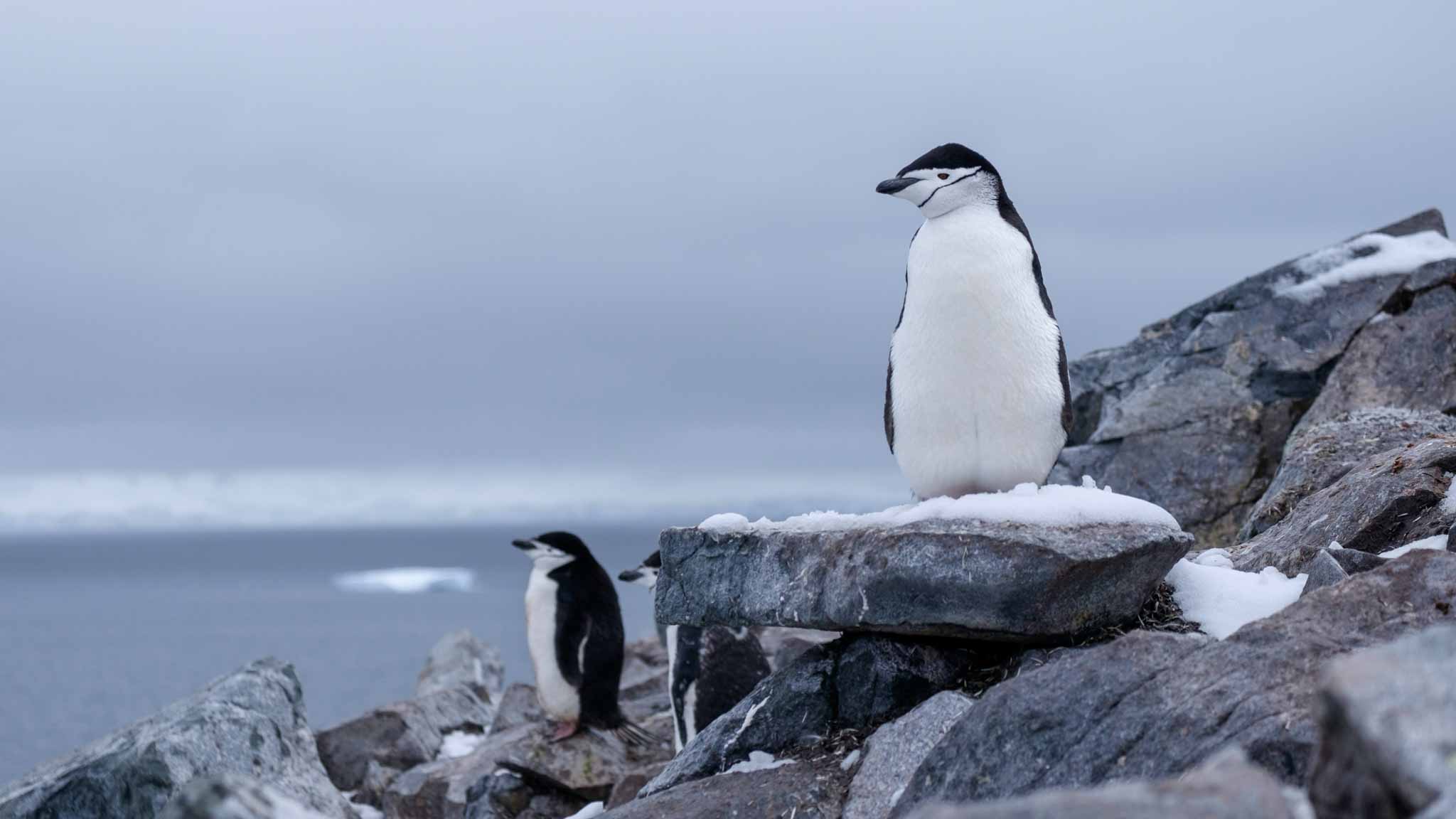
It’s a classic image, but one that could never exist. Polar bears live only in the Northern Hemisphere, circling the Arctic. Penguins, on the other hand, belong entirely to the Southern Hemisphere, with many species calling Antarctica and its surrounding islands home. Their paths never cross.
And Santa Claus?
He, too, belongs to the North Pole, thousands of kilometers away. Antarctica has no toy workshops, no reindeer, and no elves. What it does have is something far more fascinating: reality that outshines the myths.
The Antarctic Ocean: Cold, Yes—Empty, No

Another widespread assumption is that Antarctica is too cold to support life. The truth is almost the opposite at least in the ocean.
The Southern Ocean surrounding Antarctica is one of the most productive marine ecosystems on Earth. At its heart is krill, tiny shrimp-like creatures that form the foundation of the food web. Where krill thrive, life follows.
Whales migrate thousands of kilometers to feed here. Seals haul themselves onto ice floes to rest. Albatrosses glide endlessly above the waves. From microscopic plankton to the largest animals ever to live, Antarctica is bursting with life just beneath the ice.
Cold does not mean lifeless. It often means highly specialized.
Life on the Frozen Land
On land, life is quieter but no less remarkable.
Antarctica’s plant life is sparse, shaped by extreme cold, dryness, and relentless wind. Instead of forests or grasslands, the continent is dominated by non-vascular plants: mosses, liverworts, lichens, and algae. These hardy organisms cling to rocks, grow in meltwater trickles, and survive months of darkness.
Only two flowering plants manage to exist here, both hugging the Antarctic Peninsula where conditions are slightly milder. Their presence is a reminder that life adapts even at the edge of what seems possible.
Not Always as Cold as You Think
Antarctica is famous for cold, and rightly so, it holds the record for the lowest temperature ever measured on Earth. But it is not locked in perpetual deep freeze.
In coastal regions during summer, temperatures can rise above freezing. On rare occasions, they have reached around 8 °C. For humans, that might feel chilly. For Antarctica, it’s practically warm.
Yet another surprising fact: more than half of Antarctica’s landmass lies over 2,000 meters above sea level. This makes it the highest continent on Earth on average, a frozen plateau where thin air and altitude add to the harshness.
A Continent Without Cities but Not Without People

No one is born in Antarctica, and no one settles there permanently. But people do live and work on the continent, sometimes for months, even years at a time.
Scattered across the ice are research stations operated by countries from around the world. Scientists study climate, biology, geology, and space itself, enduring isolation and darkness in winter, and endless daylight in summer.
One remarkable place is Base W, a historic British station from 1956, preserved almost exactly as it was left, tools, bunks, and supplies frozen in time.
Nearby, on Ardley Island, a summer research station continues the tradition of scientific presence, reminding us that Antarctica is observed, not owned.
The World’s Greatest Natural Laboratory
Antarctica’s true value lies not in conquest or resources, but in knowledge.
Protected under the Antarctic Treaty, the continent is dedicated to peace and science. Military activity is banned. Territorial claims are set aside. Cooperation replaces competition.
Here, scientists drill deep ice cores that reveal Earth’s climate history going back hundreds of thousands of years. Tiny air bubbles trapped in ice show past levels of carbon dioxide, helping us understand how the planet responds to warming.
Antarctica also acts as a barometer for global change. Melting ice affects sea levels worldwide. Shifts in ecosystems ripple through the oceans. Even microplastics, once thought absent here are now being detected, showing how deeply human influence reaches.
Its remote, stable environment also makes Antarctica ideal for astronomy, allowing scientists to study the universe with minimal atmospheric interference, and for researching extreme life that may resemble organisms on other planets.
The White Continent, Still Full of Questions

Antarctica is often imagined as empty, finished, fully understood. In reality, it is one of the least explored places on Earth.
Beneath kilometers of ice lie mountain ranges, lakes sealed off for millions of years, and geological records we are only beginning to read. Its ecosystems are changing. Its ice is responding to a warming world. Its secrets are far from exhausted.
The frozen continent is not just a land of ice. It is a mirror, reflecting the past of our planet and hinting at its future.
And perhaps the greatest myth of all is that there is nothing left to discover there.
An Article by Carina Zettel